Showing posts with label fun stuff. Show all posts

Timely prizes

Here's something fun that I feel like I should have heard about before now, what with following science news and all that.

The Center for Communicating Science has an annual challenge to (surprise!) communicate a scientific subject—in a way that an 11-year-old will understand. Which means no university level math. Obviously, my posts here are not even close to what they're looking for, since I assume at least high school chemistry, most of the time, and I like including math.

One of the two winners is a canadian PhD student in chemistry and, from the look of his videos, an all-around goof. I certainly got a few laughs out of his video, and I thought his explanation was the clearest I've ever heard.

Natural distillation

I was out snowshoeing with a friend not long ago, and ate some snow because I was thirsty. My friend made a comment about the "distilled water" taste of snow, and I suddenly realized something that, really, I've known all along—snow effectively is distilled water.

Water distillation involves vaporizing impure water, then condensing the water vapour back to a liquid. In the case of snow, water vapour in the air freezes directly into snowflake form, making them pure—distilled—water.

Raindrops, on the other hand, while they also condense out of the water vapour in the air, absorb other vapours into the drop. There are some things that absorb more easily than others, SO2 being one of the well known pollutant related compounds that absorbs easily into water, and which makes acid rain. It's a little harder (but not impossible) to dissolve other stuff into solids.

Rotten milk

I ran across an archaeological discovery where cheese-making was confirmed 7,000 years ago.

I'm sure most people know that cheese is an old-fashioned, pre-refrigeration way of preserving milk. It's a pretty interesting preservation method, because it involves a specific kind of bacterial growth—and bacterial growth is usually what's involved in things going bad. I started to wonder: how did people figure out that if you let milk rot in just the right conditions, it doesn't actually rot but turns into cheese?

Which bacteria grow depends a lot on the conditions. With specific nutrients and temperatures, certain bacteria will come to dominate. Sort of like with my home bioreactor, I kept the conditions right for the bacteria I wanted to dominate.

To my surprise, this one turned out to be quite easy, and not as much of a stretch the way chocolate was.

Home bioreactor

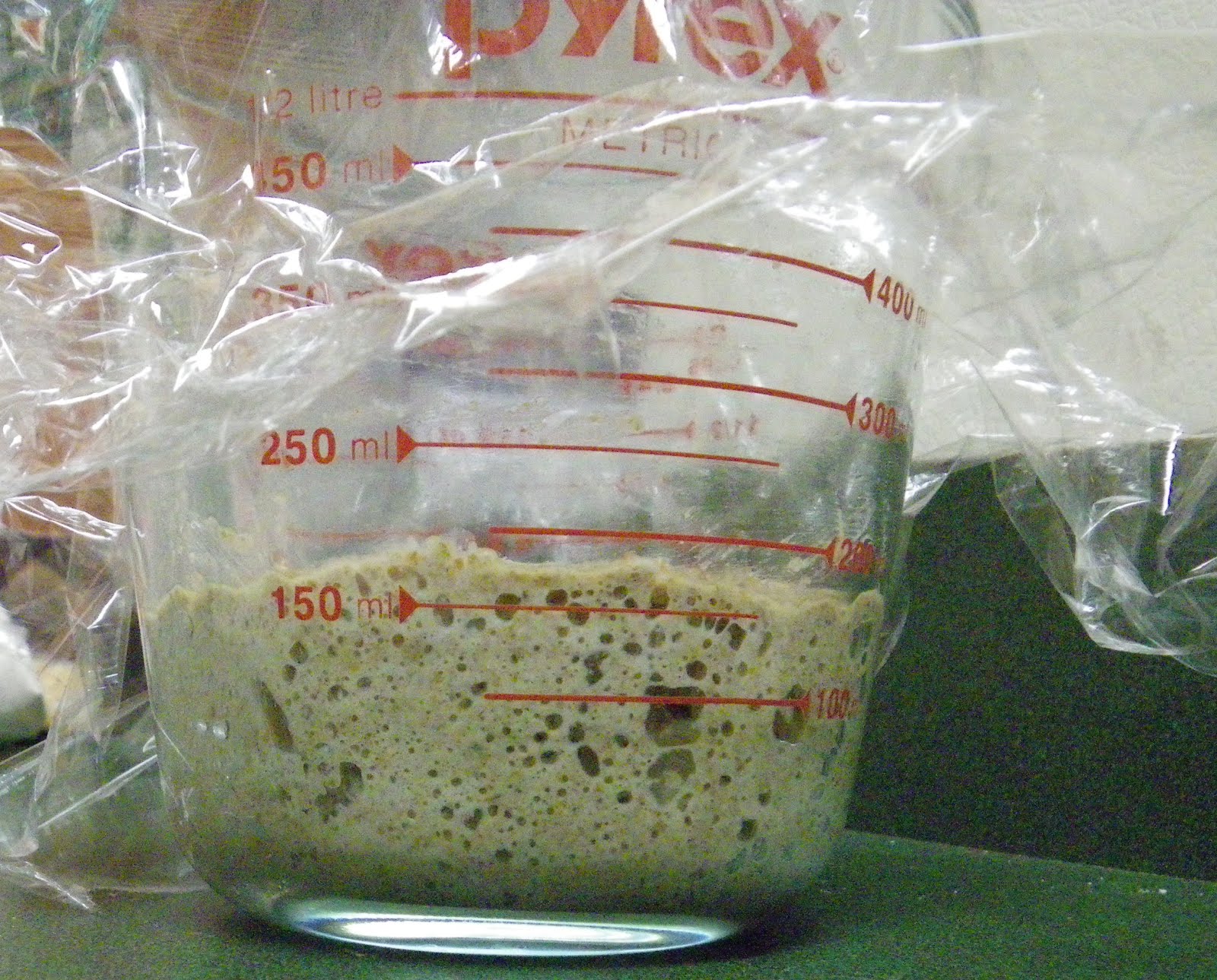
I now have a home bioreactor.

This is what it looks like 48 hours after startup:

Of course, I only realized after the bugs started farting all that CO2 that I didn't actually have a microscope at home to see what they were doing and what was there. I may have to start a second bioreactor after finding myself a microscope capable of seeing who's at home in that jar, to see how the population changes over time.

Hmm, it looks like telescope stores often sell microscopes as well. Magnifying optics are magnifying optics, I guess!

Boiling with salt

Getting back into chemistry after last week's fun little diversion into mechanics, I feel like doing some more math. I was looking for a recipe not long ago and ran across repeated mentions that one adds salt to water when boiling food in order to raise the temperature at which the water boils, thus cooking the food faster.

Boiling point elevation is a real thing, as is freezing point depression, and it's not hard to calculate.

The boiling point of pure water at sea level is 100oC. In order to calculate the change in temperature, we need the following equation:

\[\Delta T = K_b m\]

Not a sunrise, but a galaxy rise

I just discovered the "Symphony of Science" series of music videos. Gorgeous visuals in this one, both on the screen and inspired in my head by the lyrics.

I don't really have much to say about it, except that it makes me happy when I watch it. This music video has lyrics made entirely from recordings of things said by Carl Sagan (with a verse by Stephen Hawking), with their tone digitally altered to fit the melody.

Surface tension

Here's a little random bit of fun for today: kitchen games with surface tension.

One of the things that changing surface tension does is determine how stable bubbles are. So, let's change the surface tension of boiling water with some common household items.

If you set a pot of water on the stove to boil, the lid will rattle when it gets going, and that's about the extent of it. The bubbles pop quickly and aren't very stable.

If, on the other hand, you set a pot of water with some white rice in it on the stove to boil (and forget to turn it down to low the instant it starts to boil) it'll foam up and boil over and make a great big mess of your stove. If you're one of the other three people left in the world who both cooks rice and hasn't got a rice cooker, you've probably had this happen to you at least once.

A while ago I noticed something interesting: there are certain additives you can put in a pot of white rice that changes the surface tension yet again, so it goes back to not boiling over. My favourite of these additives is ground coriander seed, stirred in while the water is still cold. Also, it makes for some really tasty rice. Garlic powder also helps: while the water still foams, it doesn't grow as tall and boil over as quickly.

What did I learn?

Some random stuff I've learned from my field work: some of this is really blindingly obvious in retrospect, but which I didn't learn in university and thus didn't think of until I ran into it, sometimes embarrassingly face first and sometimes by trying to use an existing bad design.

> Operations and maintenance don't like crawling on their hands and knees on gravel to get at equipment that needs maintenance.

I told you some of these would be blindingly obvious. I have seen limited access to not only equipment for maintenance, but also to valves that need to be used on a regular basis. I have also personally needed to work a valve several times per day where I had to thread my hand between several tubes just to reach it. Fortunately I have skinny hands, and none of the tubes were hot.

What did you learn?

While I was at the National Academies Press website downloading stuff for a previous post, I ran across a title in their catalogue that caught my eye:

Surrounded by Science

Since it was free, and it was about everyday science everywhere and teaching people about science, I downloaded it. Because, you know, Science!

I was nodding right from the first two paragraphs of the preface. Do you remember going to some museum, or aquarium, or other educational and fun location, get interested, have a fun time, then at the end of it get asked by your teachers or parents, "what did you learn?"

And then drawing a blank.

The funny thing is, the first thing I thought of when I read that was actually back in university, when halfway through any given class the professor would announce the date of the midterm: my first thought was usually to wonder what he could possibly test us on, we hadn't hardly learned anything.

I don't know if the book answers the question of how to help kids answer the question "what did you learn?" (I haven't finished reading it yet) but it certainly tries to answer the question of how to help people learn and absorb and integrate science more effectively.

Personally I think instead of asking what they learned, you should ask your kid what were some of the cool things they saw. They'll probably surprise you with the amount of stuff they learned. (I saw a deer with fangs at a museum once. That was seriously weird.)

Rusty mittens

Just for fun, and because it's winter, I thought I'd look at mitten heaters, specifically the non-reusable type that comes with a warning not to take the plastic off until you're ready to use them. You've probably seen them sold with outdoor recreation stuff, such as camping gear. They're little cloth pockets with a powder inside, and you can stuff them inside your shoes or mittens to help keep warm.

There are a few ingredients in that powder, but only one produces heat. I think the others moderate the speed of the reaction so it lasts about a half hour, instead of getting a lot hotter and only lasting a few minutes.

The source of heat is a multi-step, electrochemical reaction: rust.

Fake snowflakes

You know how they say no two snowflakes are alike?

It turns out that they're so sensitive to the conditions they form in, and are also fragile in a turbulent area, that the odds of two snowflakes growing in precisely the same way and having the exact same collisions breaking pieces off as they go are pretty small.

There are, however, a few main shapes of snowflakes that all snowflakes follow.

Gravitational assumptions

I was working on some fluid flow at work the other day, and while trying to determine whether I could use gravity flow between a series of tanks or whether I had to put a pump in there somewhere, I wondered how a chemical plant built in microgravity would work.

Fluids or solids move because they have potential energy. (Once they're moving they also have kinetic energy.) So what kind of potential energy could, say, a pipe full of water have, if it didn't have gravitational potential and thus couldn't do any kind of gravity flow?

The first thing I thought of was pressure; this is how pumps overcome gravity and lift liquids uphill. Absent gravity, building up pressure at one end of a pipe would push the fluid toward the other, lower pressure end.

The Chocolate Process

Chocolate, as you probably know, comes from cocoa trees, but to get from the tree to edible chocolate takes a fair bit of processing. In short, the cocoa beans are removed from the pod, fermented, dried, roasted and shelled, ground, and sweetened.

I can understand why ancient people paid any attention at all to these seed pods; when you cut through the thick rind, the white pulp the seeds are embedded in is delicious straight off the tree. However, the seeds are pretty bitter and nasty tasting when raw. How did they ever go from "suck on this but don't crack the seed open" to "ferment+dry+roast+grind+sweeten = delicious"?

Identified Hovering Objects

Just pretty pictures today; the post I had been planning on for today is turning out a bit more complicated than I had figured. This will probably happen again. That's the thing about learning new stuff... it always takes longer than you think it will.

Sao Paolo

Syria