Showing posts with label nano. Show all posts

Inspired by: bacteria

Here's another one where nature meets engineering on a microscopic scale: tiny submarines small enough to swim through your blood vessels.

Oops, wrong link.

The submarines I'm actually talking about won't carry people, but once built they could be made to carry small doses of medicine, and directed to swim to a specific spot in your body.

The reason this merits a mention in the "nature meets engineering" category is that down at the 10\(\mu\)m scale (which is to say, 100 of these lined up end to end would only reach 1mm long) you can't just build a tiny motor and propeller and expect to have the submarine go anywhere, because at that scale, the physics of it just doesn't work. Instead, what they looked at was how creatures that are actually that small get around.

Olympicene: just to see if we can

Not too long ago, a picture from the world's most sensitive atomic force microscope was published, which showed the internal structure of a fairly small organic molecule: a 5-ring snippet of graphene, which is currently a hot and sexy topic in carbon chemistry.

The AFM in question has a sensor "needle" made of a single carbon monoxide molecule, and it's small enough to measure the gap in the middle of a six-carbon hexagonal ring structure, of which olympicene has five.

Will olympicene be a useful compound? I don't know. It's one of a class of potentially useful compounds. Even if it turns out not to be useful itself, learning how to control the reactions to create it is useful in learning how to create other molecules, and learning how to get a clear image of it is useful in learning how to get clear images of other molecules, so we can directly see what shape they are.

And here's an interview with the people who made it:

Chemical wires

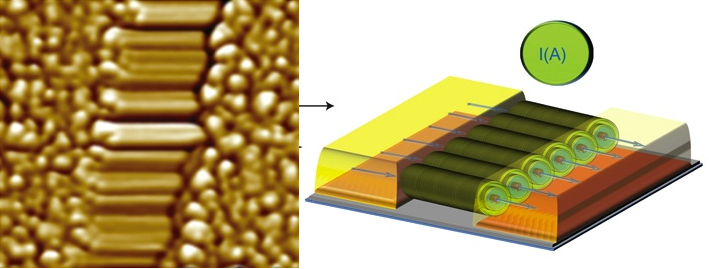
For the ever-shrinking world of micro-electronics, I hear the size of the wires themselves are a tricky problem to handle. For one thing, how do you place and solder a wire that's only a dozen atoms across? I don't work in micro-electronics (or any kind of electronics) so that's all I'll say about that.

However, a new nanowire has recently been connected between two tiny electrodes. It's so tiny it can only be seen under an atomic force microscope, and this is what it (well, a whole series of them) looks like:

They conduct nearly as well as copper, and made extremely low-resistance contact with the electrode surfaces they're connecting. Even better? They're self-assembling with an easy to control "on" switch, and charging the electrodes before triggering the self-assembly means the wires build themselves between the charged electrodes and nowhere else.

Weird water

Water, despite the fact that it's incredibly common, is actually a pretty strange compound. Some of its stranger properties make it particularly useful for life, such as the way it switches from getting denser as it gets colder (normal) to getting less dense as it gets colder (not normal) below 4oC.

A recently discovered and even more recently characterized weirdness of water is that on the nano scale and on hydrophobic surfaces, water spontaneously flows in instead of being expelled the way one would expect based on the usual reaction of water to hydrophobic materials: (blue in the image below)

Nanostamp

Nano-scale devices have been around for a while now, filling functions such as chemical sensors of extraordinary sensitivity and selectivity, your computer's CPU, and the read/write head on the hard drive. There has also been a lot of progress on what people would recognize as nanomachines, too: motors, gears, switches, all on the nano-scale.

In most cases, however, they're still difficult to make, using the same sorts of high-purity, cleanroom processes as for computer CPUs. Yes, those are in mass production as evidenced by how there are computers in everything these days, right down to doorknobs, but it's still an intensive process requiring extreme purity and cleanroom procedures.

Until recently, that is: some nanoscale devices can now be made easily, even with something as crude as a tabletop vise. Plus, the crucial part, a stamp.

The stamp was made using the cleanroom process, and once complete it can stamp out multiple copies of the actual device outside of a cleanroom, which makes them much cheaper and faster to produce.

One thing that is particularly interesting to me as a chemical engineer is how simply changing the coating on the nanostructured surface (for example, a tiny diffraction grating) changes what chemicals it detects (or more specifically, what chemicals stick to it). Then, on shining a light on it, the presence of those stuck chemicals changes the reflection or diffraction pattern in a way that's proportional to the amount of chemical adsorbed. And, moving outside of my field of expertise, biological molecules can be very specific in what will stick together and what will not. There's a lot of work going on to make these sensors to detect specific enzymes or enzyme activity that are characteristic of a disease, antibodies, and even parasites.

Making these sensors faster and cheaper means that development of useful tests for hospitals, and maybe eventually your GP's office, will speed up dramatically.