Showing posts with label pressure. Show all posts

Chilly chemical properties

Because it's the middle of winter here in Canada, I think today is a good day to talk about refrigeration.

Just kidding. Actually it's because the ISS had to replace a piece of its refrigeration system last week, and I thought that was a good excuse to talk about refrigeration.

Most modern refrigeration involves the chemical property \(\Delta H_{vap}\), or enthalpy (heat) of vaporization. Every substance has a heat of vaporization, and the amount of heat energy required to vaporize a substance is independent of what temperature the substance boils at. To choose a rather extreme contrast, water boils at 100C while lead boils at 1750C, but water requires 539cal/g to convert from liquid to gas while lead only needs 208cal/g, less than half that required by water. This amount of heat does not account for how much is required to get to the boiling point, and if you remember your high school chemistry, the temperature does not change with the additional heat input while it changes from liquid to gas.

The basic principle in use here is that when a substance evaporates, it draws heat energy from its surroundings (or the more familiar form: when you add heat to a substance, it will evaporate), and when a substance condenses, it releases heat energy back to its surroundings. Put an insulated barrier between these two sides of the process, and you have refrigerators, freezers, and air conditioners which get colder "inside" and warmer "outside".

Anti-fizz

While in Europe on a work trip and grabbing a bite for lunch at a café, I grabbed a bottle of water on my way to pay without checking the label. Checking the label is important, because in Europe, "still" water and "sparkling" (carbonated) water are sold side by side—and I can't stand the taste of sparkling water. Halfway through eating lunch, I opened the water bottle to have a drink and it sprayed water all over my tray and my clothes.

I'd grabbed the wrong sort of water. Not only that, I'd obviously shaken it at some point.

Because I'd opened it, I couldn't return it for a bottle of still water, so I decided to de-sparkle the sparkling water, in the hopes that it would improve the taste. Fortunately, this requires no special equipment and can be done in a café, although it might draw some funny looks.

Thawing sweets

Here's a thing that I didn't even know was a thing to wonder about:

You know the sugar maple, which produces the raw material for maple syrup by dripping sap into a bucket in the spring. Well, it turns out that it's not only a case of the sugar maple's sap being particularly sweet and thus well suited for this use. The sugar maple, along with a couple of other trees, are the only ones which drip their sap out in a way that can be usefully collected, and it is also particularly sweet.

The question, or rather questions, are:

Why only a few types of tree?

Why does this only happen during spring thaw, in certain temperature conditions?

How does this happen at all?

Some mathematicians from SFU on the west coast decided to calculate this east coast phenomenon.

Weird water

Water, despite the fact that it's incredibly common, is actually a pretty strange compound. Some of its stranger properties make it particularly useful for life, such as the way it switches from getting denser as it gets colder (normal) to getting less dense as it gets colder (not normal) below 4oC.

A recently discovered and even more recently characterized weirdness of water is that on the nano scale and on hydrophobic surfaces, water spontaneously flows in instead of being expelled the way one would expect based on the usual reaction of water to hydrophobic materials: (blue in the image below)

Airplane-induced snow

An airplane made that hole.

Not by just flying through it and swirling the visible cloud out of the way, that makes a different pattern which doesn't last nearly as long.

It turns out that in certain conditions, airplanes can actually induce rain or snow in a localized region of a cloud, and the precipitation is what clears the hole - the water droplets that make up the cloud fall because of the airplane.

Don't plug the pressure relief valve.

The pressure relief valve is one of my favourite pieces of safety equipment.

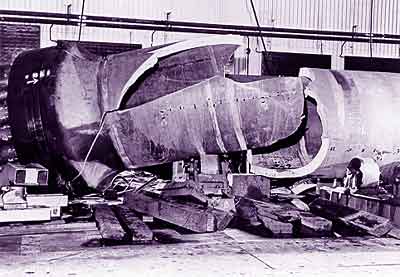
In this case, it's just a simple valve that's designed to leak if the pressure gets above a certain point on one side. By letting a small leak happen, you avoid having the pressure get higher than the tank or pipe is designed to handle. If the pressure in a tank gets higher than it's designed to handle, you get stuff like this:

They aren't only on large industrial systems though.

That one was a little bitty (5 gallon, according to the public safety notice I found it on) hot water tank that exploded. A full size hot water tank does a lot more damage, such as done by this 80 gallon commercial hot water tank installed for a school cafeteria. Did I mention you don't ever plug the pressure relief valve? It's there for a reason.

And because it involves explosions, mythbusters naturally did a couple of episodes to find out if a hot water tank really does launch itself like a rocket and if it really can punch through the 2nd floor then the roof of a 2-story house.

So yeah, if your hot water tank has a dripping valve, don't plug it—call the repairman and put a bucket under it until then.

The reverse of a pressure relief is a vacuum relief, which lets air into tanks that you're emptying. Like this one:

Gravitational assumptions

I was working on some fluid flow at work the other day, and while trying to determine whether I could use gravity flow between a series of tanks or whether I had to put a pump in there somewhere, I wondered how a chemical plant built in microgravity would work.

Fluids or solids move because they have potential energy. (Once they're moving they also have kinetic energy.) So what kind of potential energy could, say, a pipe full of water have, if it didn't have gravitational potential and thus couldn't do any kind of gravity flow?

The first thing I thought of was pressure; this is how pumps overcome gravity and lift liquids uphill. Absent gravity, building up pressure at one end of a pipe would push the fluid toward the other, lower pressure end.

Hydrophones at depth

Here's a nifty new piece of technology from Stanford University for any ocean-science types: a hydrophone that can be used at any depth which has low-distortion sound detection over a dynamic range of 160dB and a frequency range of 1Hz to 100,000Hz. By contrast, the human ear can hear a range of about 20-20,000Hz, feels immediate and acute pain at about 120dB—chronic damage starts much lower, down about 85dB. (If you want to know what 120dB feels like, stand about 3m in front of an emergency vehicle with its siren sounding.)

Most microphones have a thin diaphragm which vibrates in response to the sound waves hitting it, and this one is no exception. However, when you're detecting tiny pressure changes against the crush of a deep ocean trench, you need something that will not be overwhelmed by the ambient pressure. The answer for this particular microphone was to drill tiny holes in the diaphragm so that the water pressure on both sides of the diaphragm is the same. The holes would have to be small enough that sound waves in the water wouldn't pass right through them without moving the diaphragm, and large enough that the pressure would equalize before damaging the diaphragm as it's brought to depth. The diaphragm itself is about 500nm thick, so it is very fragile. To measure the movement of such a fragile surface, they use a laser. This is highly accurate and also doesn't touch the diaphragm with anything other than light. At the quiet end of the sounds they wanted to measure, and with water resisting the motion of the diaphragm, it moves only about 0.00001nm or so. Fortunately, lasers and mirrors can detect that sort of tiny movement.

Different sizes of diaphragms (and drumskins, and sound boards, and strings, and horn tubes) are most responsive to a particular frequency, so to cover the full range of frequencies they wanted to hear without distortion would be tricky with only one diaphragm. So, they put three different sizes of diaphragm in one microphone to cover the range.