Showing posts with label biology. Show all posts

Oily algae

Algae, as well as other biologically sourced feed stocks, has been the subject of a lot of research in oil production, for what should be obvious reasons. There are several things about using some bio-sources that concern me, however. Using food cropland to grow corn or soy intended for conversion to fuel, for one, resulting in less food production (and contributing to higher food prices).

The bio-sources that don't bother me in this way are things like manure or other waste to bio-fuel. Even wood waste and scrap paper can be turned into either oil or syngas (which can be turned into oil, among other things).

But, an interesting comment in a recent press release about oil from algae caught my eye: "byproduct stream of material containing phosphorus that can be recycled to grow more algae."

Chemical telephones

The folks at UCLA have come up with a way to use cell phones to test for allergens in food. And we're not talking looking it up in a database somewhere, we're talking an actual lab test, which tests the actual piece of food in front of you.

Potentially useful if you have a life-threatening allergy, such as to peanuts, the example used in their paper.

While this does use the camera built into the phone, as a lab test, it is more than just taking a picture. Specifically, it uses a colorimetric process to measure how much allergen is in the sample.

I've used colorimeters before, and they are generally quick and handy (and portable, if you buy the portable version of the reader). However, that "generally" is important. While I've used some colorimetric kits that only take 5 minutes, I've used some that take over half an hour, and that's not counting sample preparation time.

And all of those kits require sample preparation of some sort, adding chemicals, and waiting for the reaction to finish before measuring. Most of the stuff I tested required dilution of a water sample to bring it into the testing range. The peanut test described requires the sample to be finely ground and dissolved first, and is described as taking 20 minutes, not including grinding time.

The good kits come with either pre-measured chemicals or easy quantities of liquid chemicals to measure, such as with a standard pipette or a supplied dropper, to minimize test error. The reaction of the compound of interest with the added reagents causes a colour change, which the sensor (or camera) measures. Generally, at least for the kits I've used, the darker the colour, the more of the compound of interest is present. From the paper, it looks like the peanut test turns red.

Realistically, now that the photo processing and colour measurement has been sorted out, any pre-existing colorimetric kit could be adapted for cel phone use. But then, most people who might get these things for personal use would be more interested in allergens than the stuff I have tested for at work. Most people don't care all that much how much calcium is in their water, because it isn't a health issue.

(Ok, technically this one is almost year old, but I don't restrict myself to only talking about new discoveries.)

Biodegradation experiment

Quite a few months ago, I mentioned a test I thought I might run. I didn't start it at the time because it was winter and my assistants for this particular test tend to be sluggish when it's cold out. Then I forgot about it for a while.

For those who followed the link above, yes, I'm talking about that test.

Meet my lovely assistants, who will be doing the actual work of the biodegradation test! It's summer now, and they're happily eating through my kitchen scraps.

Thawing sweets

Here's a thing that I didn't even know was a thing to wonder about:

You know the sugar maple, which produces the raw material for maple syrup by dripping sap into a bucket in the spring. Well, it turns out that it's not only a case of the sugar maple's sap being particularly sweet and thus well suited for this use. The sugar maple, along with a couple of other trees, are the only ones which drip their sap out in a way that can be usefully collected, and it is also particularly sweet.

The question, or rather questions, are:

Why only a few types of tree?

Why does this only happen during spring thaw, in certain temperature conditions?

How does this happen at all?

Some mathematicians from SFU on the west coast decided to calculate this east coast phenomenon.

Arsenate: love it or hate it?

Science makes yet another super-interesting discovery that started from a "wait, that's weird" moment. One which was initially misinterpreted, too.

So a while back there was a big splash in the news about some bacteria which had been isolated from a lake that was quite high in arsenic, where said bacteria—and other creatures—were thriving despite the arsenic.

It wasn't just that the bacteria could live in an environment containing arsenic, as there were already known bacteria which "breathe" arsenate; it was that the initial tests seemed to show that the bacteria could grow in the absence of phosphate, by substituting arsenate for phosphate.

This last conclusion turned out to be incorrect. However, the bacteria could still thrive in lab environments where the phosphate to arsenate ratio got completely absurd—as long as there was a trace of phosphate there. That in itself was pretty strange, because arsenate is a deadly poison.

Bioreactor growth rates

My home bioreactor took 48 hours to get going where the instructions said 24-36 hours was typical, but it got going. About two weeks after startup the active cell culture had matured and I decided to put it into production. The instructions indicated that 1.5 hours at room temperature would be an adequate first stage reaction period. Four hours into it the first reaction stage wasn't finished, so I put the lot into the fridge and went to bed; clearly the time estimates were not representative.

I knew putting it in the fridge would slow the reaction down to the point where I could pick it up again the next day, because it's a bioreactor and they're sensitive to temperature - specifically, the reproduction rate of the cell culture slows down dramatically when cooled.

That's when I realized that my bioreactor had been reacting more slowly than the instructions suggested was normal every step of the way.

Calcium Catastrophe

Generally speaking, a sudden drastic change in the chemistry of your environment is catastrophic. From bacteria to humans, there is a range of chemistry we can tolerate, and outside that range we tend to die.

I mentioned one major geochemical event last year, when free atmospheric oxygen first became common. That was a pretty catastrophic change for the living creatures (bacteria) who were adapted to the pre-oxygen conditions of the early earth.

Some time after that, another major geochemical event happened. Some researchers now think that this led directly to the cambrian explosion and to more complex life on earth. Even so, it was a catastrophic change—from the point of view of the creatures who didn't survive it.

Home bioreactor

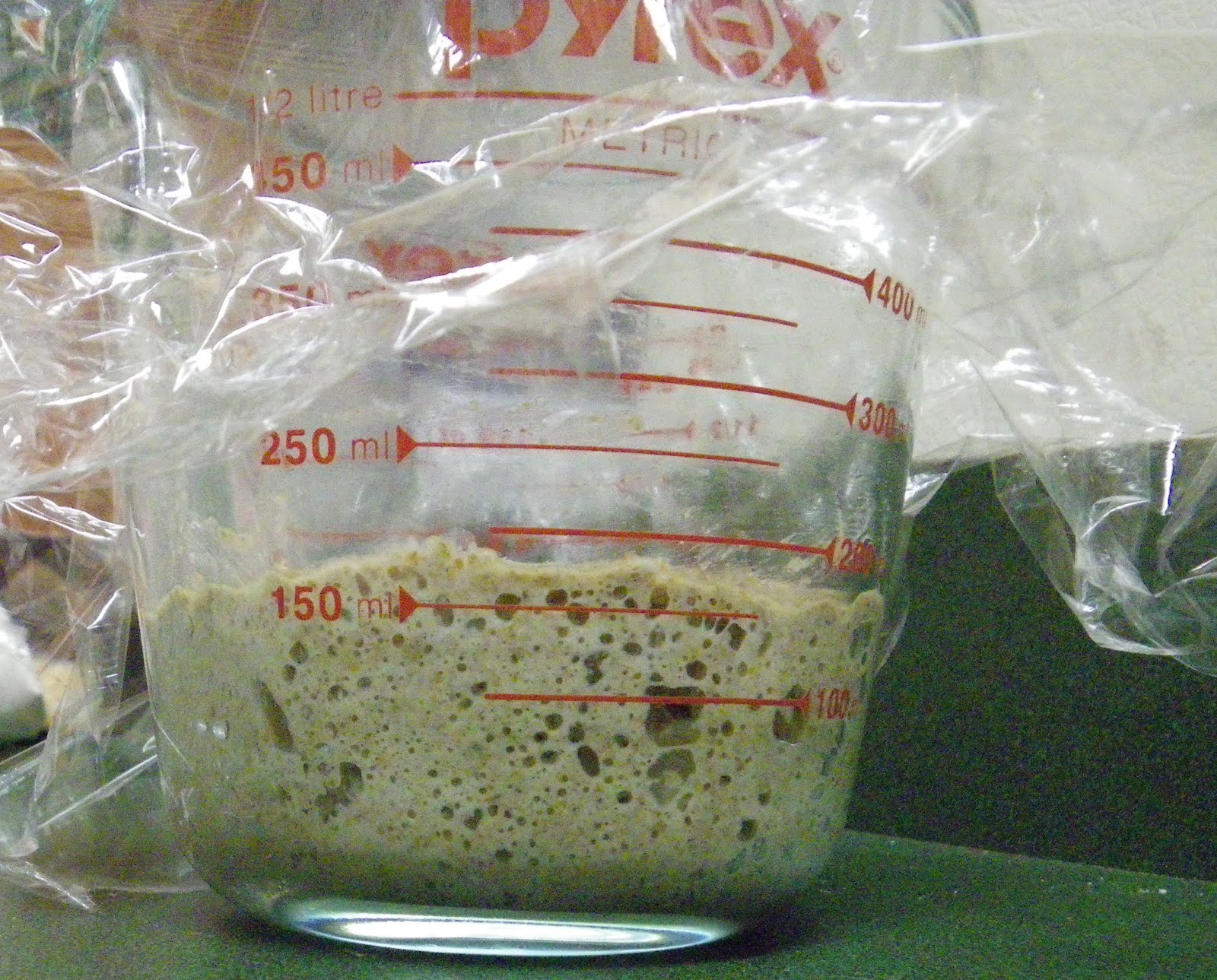
I now have a home bioreactor.

This is what it looks like 48 hours after startup:

Of course, I only realized after the bugs started farting all that CO2 that I didn't actually have a microscope at home to see what they were doing and what was there. I may have to start a second bioreactor after finding myself a microscope capable of seeing who's at home in that jar, to see how the population changes over time.

Hmm, it looks like telescope stores often sell microscopes as well. Magnifying optics are magnifying optics, I guess!

Mortality

Here's a pair of medical terms I have often seen together. One of them I thought I had a moderately good understanding of the meaning, and the other I wasn't really sure exactly what it meant.

As with my previous post in this series, the same comment applies: If a medical doctor happens to read this and notices that I have something wrong, I would be thrilled to get a correction. I'm not a doctor and I'm writing this for other not-doctors; while I'm ok with simplification I don't want to be wrong.

Now, for my pair of terms: mortality is the former; it means how many people die. (Rather appropriate for a Hallowe'en post!) But it's also more than that; it is, specifically, the number of deaths in a given group over a given time period, and what the group and time period is has to be defined. The restrictions make sense, once I stopped to think about it: ultimately, the mortality of humans is 100% - everybody dies of something, at some point. But if you look at the mortality of a disease, or a type of accident, then the group is restricted to the people who have that disease or that injury, and the time is restricted to the time of the study, and the mortality is less than 100%. Something else kills the other people in the study at some other time, not covered by the study.

Acid and oxygen

Acid rock drainage is one of the big environmental problems facing hard rock mines, because it keeps going for decades after the mine is closed and abandoned, poisoning everything downstream with the toxic metals leached from the rock. It's a natural process that occurs wherever rock is exposed to oxygen and water; metal sulphides are oxidized by the oxygen to dissolved metal and sulphuric acid. Exposed rock is eventually consumed until there is little to no unreacted metal or sulphide accessible to oxygen.

However, as the process requires oxygen, it couldn't happen until the earth's atmosphere actually had oxygen in it. I haven't yet found a definitive description of what exactly the earth's atmospheric composition was before the change, but the difference between chemistry with and without oxygen is pretty clear, as oxygen is highly reactive and tends to get into everything. For one, the acid rock drainage I mentioned above. Another indication is the type of iron minerals deposited—with or without oxygen, and how much oxygen. As iron combines very easily with oxygen, if you find an iron deposit without any oxygen there's a good chance no oxygen was available to it at the time it was formed.

Research

I've been following the Science Based Medicine blog for a while now (even though I'm not a doctor) and one of the things I realized is that medical research is a whole lot more complicated than, say, chemistry. In the sort of trials I might do, if you put the same ingredients in a jar, you'll get the same results every time. In medical trials, this isn't the case, because human bodies are a whole lot more complicated than even a jar full of a hundred different chemicals. I sort of already knew this, but some of the articles on SBM have really made this clear to me.

Another thing I realized is that there is a lot of vocabulary around these trials which I only partially understood. So, here is my attempt at explaining this stuff more completely to myself. And, as it says in my sidebar, "I thought I'd share."

(If a medical doctor happens to read this and notices that I have something wrong, I would be thrilled to get a correction. I'm not a doctor and I'm writing this for other not-doctors; while I'm ok with simplification I don't want to be wrong.)

The first one I'm going to cover is clinical trials.

Biodegrading ... into what?

"Biodegradable" is one of many words commonly used to indicate something is environmentally friendly, but like many technical terms, it often doesn't mean the same thing in common usage as it does to a scientist. To me, "biodegradable" just means that the substance in question can be processed by some biological route into some other, usually lower molecular weight, substance.

It says nothing about the toxicity or harm—or benefit—that might be caused by the new substance.

Nanostamp

Nano-scale devices have been around for a while now, filling functions such as chemical sensors of extraordinary sensitivity and selectivity, your computer's CPU, and the read/write head on the hard drive. There has also been a lot of progress on what people would recognize as nanomachines, too: motors, gears, switches, all on the nano-scale.

In most cases, however, they're still difficult to make, using the same sorts of high-purity, cleanroom processes as for computer CPUs. Yes, those are in mass production as evidenced by how there are computers in everything these days, right down to doorknobs, but it's still an intensive process requiring extreme purity and cleanroom procedures.

Until recently, that is: some nanoscale devices can now be made easily, even with something as crude as a tabletop vise. Plus, the crucial part, a stamp.

The stamp was made using the cleanroom process, and once complete it can stamp out multiple copies of the actual device outside of a cleanroom, which makes them much cheaper and faster to produce.

One thing that is particularly interesting to me as a chemical engineer is how simply changing the coating on the nanostructured surface (for example, a tiny diffraction grating) changes what chemicals it detects (or more specifically, what chemicals stick to it). Then, on shining a light on it, the presence of those stuck chemicals changes the reflection or diffraction pattern in a way that's proportional to the amount of chemical adsorbed. And, moving outside of my field of expertise, biological molecules can be very specific in what will stick together and what will not. There's a lot of work going on to make these sensors to detect specific enzymes or enzyme activity that are characteristic of a disease, antibodies, and even parasites.

Making these sensors faster and cheaper means that development of useful tests for hospitals, and maybe eventually your GP's office, will speed up dramatically.

Life-giving crystals

Another piece of the puzzle that is life has fallen into place, and it is a spiky crystal.

That right there is one powerful crystal: it is the chemical precursor to RNA, the earliest self-replicating molecule that science is aware of, and thus the starting point for life. It grew from a mixture of basic, common organic chemicals in the presence of a few common amino acids, and is stable and will stay put until the next step, converting it to RNA, takes place.

Not only that, but it's the correct form of the two possible enantiomers that the RNA precursor can take, and it grew naturally out of a mixture of chemicals that didn't start out composed of the pure correct enantiomer, but of a racemic mixture plus a nearly racemic mixture of amino acid that had only 1% excess of the enantiomer they wanted.