Showing posts with label food. Show all posts

Edible education

One subject I've had in my list to write about (once I spent the time to find some good sources) was why some leaves are edible while others aren't—completely aside from the question of toxicity, there are lots of plants that we simply can't digest. I hadn't yet got around to digging into the subject when I ran across the answer recently, along with loads of other interesting information about food chemistry.

A few weeks ago I discovered a free, online course offered by McGill University via edX, on the subject of food and nutrition. Despite being offered by the chemistry department there, it doesn't require more than high school chemistry and the ability to use a 4-function calculator as prerequisites, and I'm not even sure if it needs high school chemistry. You should probably know the difference between an atom and a molecule, and at least recognize the Periodic Table of the Elements.

I was too late to sign up for the credit version, where the assignment deadlines are enforced, but there is a non-credit, audit version (which I'm doing) where you still have access to all the video lectures, discussions, and mini-quizzes.

So back to edible vs. non-edible leaves.

In the lesson on carbohydrates, (week 4, lesson 1) they showed the chemical structure of starch vs. cellulose (video 8). Both are long strings of glucose connected by oxygen atoms, but the way they're strung together is different—and that's it. That's the difference between plants we can digest and plants we can't. (Plants we can digest still have cellulose in them and we pass that through our system no problem—but we don't get any nutrition out of it.)

(Screenshot from Food for Thought, week 4/lesson 1/video 8. Requires free course registration to view.)

They look very similar at first glance, but if you look closely, they have an important difference: every second glucose segment is upside down in the cellulose chain.

We have the enzymes necessary to digest starch. We don't, but cows and other ruminants do, have the enzymes necessary to digest cellulose.

Enzymes are complicated things which have a very specific shape, and can fit around molecules of a very specific shape. So, an enzyme that fits the shape of starch in order to cut it down to its component glucose molecules will simply not fit the different shape of cellulose, even though the components are all the same.

So that was short and sweet. Also, check out the course, it's fascinating. (Keep in mind you can adjust the playback speed of the videos. I found my attention wandering because the instructors speak kind of slowly; running them at 1.5x speed makes it easier for me to keep from wandering. You can also back up and repeat sections if you don't catch it the first time through, or pause to look at the diagrams, because it's a video.)

Food chemicals

I was tossing around the idea of doing some posts on the various food additives one sees (and which some people are frightened by, due to their long chemical names) when I ran across Science Fare's list of The Ingredients of Scientific Cooking. Some of these every cook has used (sodium bicarbonate aka baking soda; sodium chloride aka table salt; ethanol aka drinking alcohol, to name the three most instantly recognizable ones), and some are a bit more specialty (such as pectin to gel a jam - mmmmm, I remember my mom's jam) and some I didn't realize people used in home kitchens. Although in hindsight, the fact that I have seen a bag of MSG in the supermarket means that yeah, people do actually use them.

This list looks like an excellent resource, though I may branch out from it and look into some of the things used only in commercially produced food, because I am curious about some of these. Especially items such as preservatives, since without them, food (and even non-food items such as sunscreen) doesn't last very long and provides a potential base for bacteria and mould, some of it potentially harmful, to grow.

Anti-fizz

While in Europe on a work trip and grabbing a bite for lunch at a café, I grabbed a bottle of water on my way to pay without checking the label. Checking the label is important, because in Europe, "still" water and "sparkling" (carbonated) water are sold side by side—and I can't stand the taste of sparkling water. Halfway through eating lunch, I opened the water bottle to have a drink and it sprayed water all over my tray and my clothes.

I'd grabbed the wrong sort of water. Not only that, I'd obviously shaken it at some point.

Because I'd opened it, I couldn't return it for a bottle of still water, so I decided to de-sparkle the sparkling water, in the hopes that it would improve the taste. Fortunately, this requires no special equipment and can be done in a café, although it might draw some funny looks.

Thawing sweets

Here's a thing that I didn't even know was a thing to wonder about:

You know the sugar maple, which produces the raw material for maple syrup by dripping sap into a bucket in the spring. Well, it turns out that it's not only a case of the sugar maple's sap being particularly sweet and thus well suited for this use. The sugar maple, along with a couple of other trees, are the only ones which drip their sap out in a way that can be usefully collected, and it is also particularly sweet.

The question, or rather questions, are:

Why only a few types of tree?

Why does this only happen during spring thaw, in certain temperature conditions?

How does this happen at all?

Some mathematicians from SFU on the west coast decided to calculate this east coast phenomenon.

Rotten milk

I ran across an archaeological discovery where cheese-making was confirmed 7,000 years ago.

I'm sure most people know that cheese is an old-fashioned, pre-refrigeration way of preserving milk. It's a pretty interesting preservation method, because it involves a specific kind of bacterial growth—and bacterial growth is usually what's involved in things going bad. I started to wonder: how did people figure out that if you let milk rot in just the right conditions, it doesn't actually rot but turns into cheese?

Which bacteria grow depends a lot on the conditions. With specific nutrients and temperatures, certain bacteria will come to dominate. Sort of like with my home bioreactor, I kept the conditions right for the bacteria I wanted to dominate.

To my surprise, this one turned out to be quite easy, and not as much of a stretch the way chocolate was.

Greenwashing and CBC #3: T-Fal Natura frying pan

Continuing from my previous post with #3 on the CBC Marketplace "Lousy Labels" greenwashing list is T-fal Natura frying pan.

As I mentioned last week, Marketplace is a 22 minute show and they did a 10-product countdown, giving them approximately 2 minutes per product, so they had to leave a lot of information out.

So, the T-Fal website claims for the Natura line that it's made from 100% recycled aluminium and the non-stick coating is PFOA-free, lead-free, and cadmium-free.

Marketplace says that PFOA is still used in the manufacturing process, and that it always has been not present in the final product, and that it likely causes cancer as well as being widespread in the environment. Also they acknowledge that 100% recycled aluminium is a good, environmentally friendly thing.

Reshaping heat transfer

The last step in production from my home bioreactor is to heat the mixture to a specified internal temperature, about 95-98C. The first few times I tried, I followed the instructions exactly and it worked great.

Then I decided that the final shape of the product when following the instructions was not as convenient to me as I would like. Using a different shaped container was in order. However, this different container was not only a different shape, it was not conducive to pre-heating and had nowhere near the capacity for storing heat and holding its temperature as the original, inconveniently-shaped container did.

I tested it out anyway, and while it did produce a final product of about the shape I wanted, the characteristics of the material in the centre had changed. It was usable, but not as easily so. I eventually figured out that it hadn't heated up right through as it should have. I tried heating it for a slightly longer period, but that didn't seem to make much of a difference.

Trial and error will take far too long. Clearly, this calls for some math.

Orange Juice Flavour

I ran across yet another news item about processed food the other day, and decided to find out a bit more about what was behind it.

For those who didn't click the link above: I'm not talking about twinkies, I'm talking about orange juice. Because make no mistake about it, unless you cut and juice oranges yourself, the orange juice you drink is chemically processed. It has to be—fresh squeezed orange juice goes bad on a time scale of a couple of days even with refrigeration. (Apparently you can buy unpasteurized OJ, but it has a "use by" date about 2-3 days after the oranges are juiced at the processing plant. I don't recall seeing it for sale in Canada, which is about a 24-hr drive nonstop from the orange groves... Doesn't mean it isn't here, only that I haven't seen it.)

Bioreactor growth rates

My home bioreactor took 48 hours to get going where the instructions said 24-36 hours was typical, but it got going. About two weeks after startup the active cell culture had matured and I decided to put it into production. The instructions indicated that 1.5 hours at room temperature would be an adequate first stage reaction period. Four hours into it the first reaction stage wasn't finished, so I put the lot into the fridge and went to bed; clearly the time estimates were not representative.

I knew putting it in the fridge would slow the reaction down to the point where I could pick it up again the next day, because it's a bioreactor and they're sensitive to temperature - specifically, the reproduction rate of the cell culture slows down dramatically when cooled.

That's when I realized that my bioreactor had been reacting more slowly than the instructions suggested was normal every step of the way.

Home bioreactor

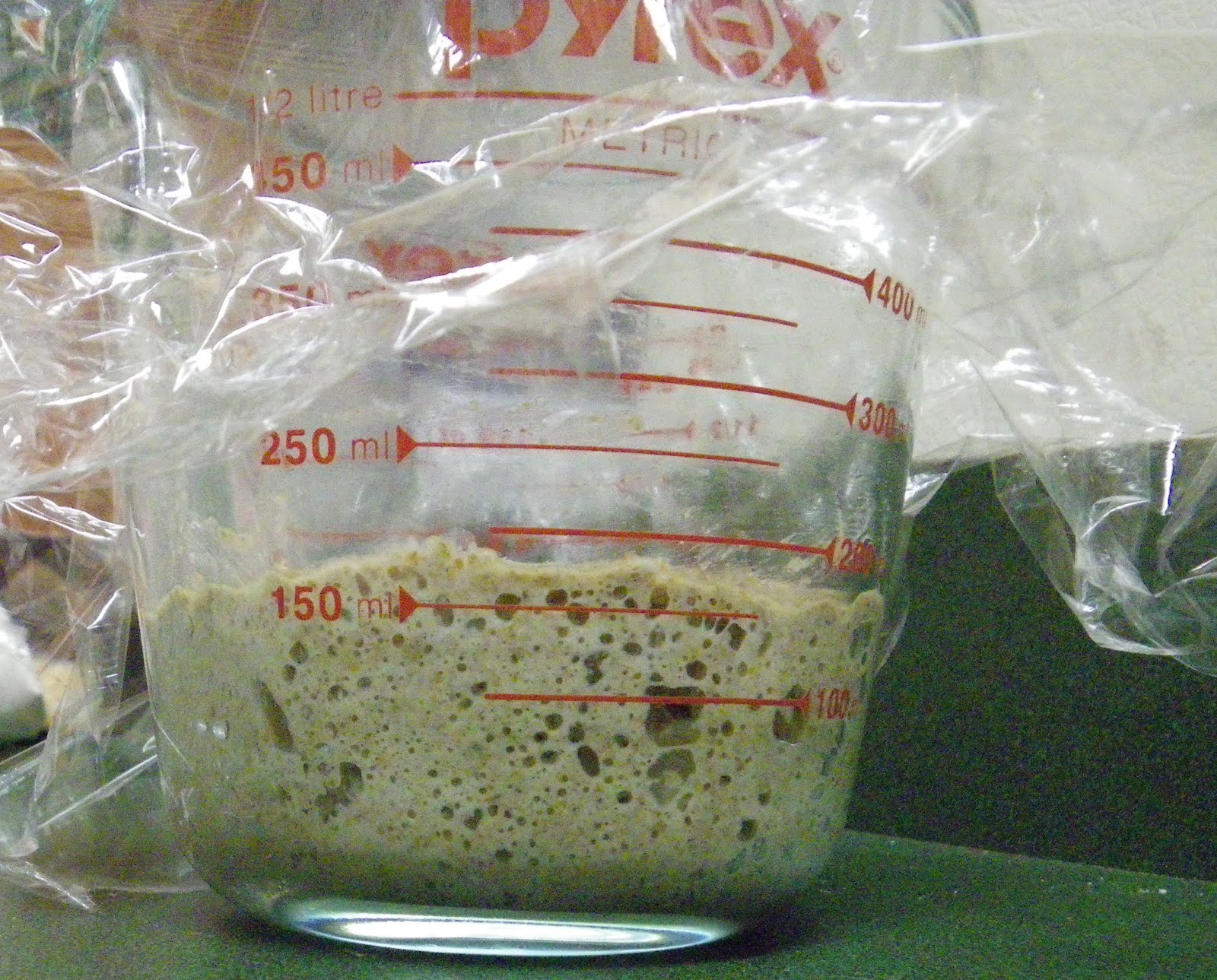
I now have a home bioreactor.

This is what it looks like 48 hours after startup:

Of course, I only realized after the bugs started farting all that CO2 that I didn't actually have a microscope at home to see what they were doing and what was there. I may have to start a second bioreactor after finding myself a microscope capable of seeing who's at home in that jar, to see how the population changes over time.

Hmm, it looks like telescope stores often sell microscopes as well. Magnifying optics are magnifying optics, I guess!

Surface tension

Here's a little random bit of fun for today: kitchen games with surface tension.

One of the things that changing surface tension does is determine how stable bubbles are. So, let's change the surface tension of boiling water with some common household items.

If you set a pot of water on the stove to boil, the lid will rattle when it gets going, and that's about the extent of it. The bubbles pop quickly and aren't very stable.

If, on the other hand, you set a pot of water with some white rice in it on the stove to boil (and forget to turn it down to low the instant it starts to boil) it'll foam up and boil over and make a great big mess of your stove. If you're one of the other three people left in the world who both cooks rice and hasn't got a rice cooker, you've probably had this happen to you at least once.

A while ago I noticed something interesting: there are certain additives you can put in a pot of white rice that changes the surface tension yet again, so it goes back to not boiling over. My favourite of these additives is ground coriander seed, stirred in while the water is still cold. Also, it makes for some really tasty rice. Garlic powder also helps: while the water still foams, it doesn't grow as tall and boil over as quickly.

Happy Thanksgiving

I'll be back next week with something. This weekend is for overeating and visiting family, not working and writing.

The Chocolate Process

Chocolate, as you probably know, comes from cocoa trees, but to get from the tree to edible chocolate takes a fair bit of processing. In short, the cocoa beans are removed from the pod, fermented, dried, roasted and shelled, ground, and sweetened.

I can understand why ancient people paid any attention at all to these seed pods; when you cut through the thick rind, the white pulp the seeds are embedded in is delicious straight off the tree. However, the seeds are pretty bitter and nasty tasting when raw. How did they ever go from "suck on this but don't crack the seed open" to "ferment+dry+roast+grind+sweeten = delicious"?