The Voyagers are still going strong

This pair was aptly named. Launched in 1977, the Voyagers are still cruising, still doing science, still sending back photos and data, still occasionally making the news. Just this past summer, they discovered bubbles in the outer edge of the sun's magnetic field, way out at the boundary of the solar system.

The most recent news is more mundane and administrative in one sense, and pretty darn amazing in another sense. The Voyagers have now switched the last set of thrusters to the backup set. Sounds kind of boring, until you realize that this means the longest lasting of the primary set of thrusters lasted for 33 years. Without maintenance. Yeah, try that with your car.

Every time I look at this set of twins, they amaze me. They were designed from the start to be deep space probes; these are the ones who carry the famous golden record (and the needle to play it—yes, it is in fact a phonograph record, only made out of gold instead of vinyl) and took the first ever picture of both the earth and the moon in the same frame. (Links at the bottom of that page to larger versions of the photo.) They're also the only spacecraft ever to have visited Uranus (1986) and Neptune (1989). Everything we know about those two planets beyond distant telescope viewing, we owe to Voyager 2.

Apparently now that they're fully switched to the backup thrusters, they can shut off the heat to the primaries and save power, and expect to get at least another 10 years out of the backup thrusters. Did I mention the backup thrusters weren't maintained for over 30 years either, and they worked fine when NASA turned them on? This just boggles my mind.

I am curious to see what they find when they finally cross out of our sun's area of influence and get into interstellar space, and I really hope their thrusters last that long. (The thrusters in question aren't their drive, they're for aiming the antenna so they can keep talking to Earth.) They just keep on finding new things!

Don't plug the pressure relief valve.

The pressure relief valve is one of my favourite pieces of safety equipment.

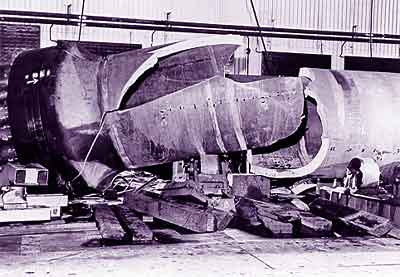
In this case, it's just a simple valve that's designed to leak if the pressure gets above a certain point on one side. By letting a small leak happen, you avoid having the pressure get higher than the tank or pipe is designed to handle. If the pressure in a tank gets higher than it's designed to handle, you get stuff like this:

They aren't only on large industrial systems though.

That one was a little bitty (5 gallon, according to the public safety notice I found it on) hot water tank that exploded. A full size hot water tank does a lot more damage, such as done by this 80 gallon commercial hot water tank installed for a school cafeteria. Did I mention you don't ever plug the pressure relief valve? It's there for a reason.

And because it involves explosions, mythbusters naturally did a couple of episodes to find out if a hot water tank really does launch itself like a rocket and if it really can punch through the 2nd floor then the roof of a 2-story house.

So yeah, if your hot water tank has a dripping valve, don't plug it—call the repairman and put a bucket under it until then.

The reverse of a pressure relief is a vacuum relief, which lets air into tanks that you're emptying. Like this one:

Gravitational assumptions

I was working on some fluid flow at work the other day, and while trying to determine whether I could use gravity flow between a series of tanks or whether I had to put a pump in there somewhere, I wondered how a chemical plant built in microgravity would work.

Fluids or solids move because they have potential energy. (Once they're moving they also have kinetic energy.) So what kind of potential energy could, say, a pipe full of water have, if it didn't have gravitational potential and thus couldn't do any kind of gravity flow?

The first thing I thought of was pressure; this is how pumps overcome gravity and lift liquids uphill. Absent gravity, building up pressure at one end of a pipe would push the fluid toward the other, lower pressure end.

Mortality

Here's a pair of medical terms I have often seen together. One of them I thought I had a moderately good understanding of the meaning, and the other I wasn't really sure exactly what it meant.

As with my previous post in this series, the same comment applies: If a medical doctor happens to read this and notices that I have something wrong, I would be thrilled to get a correction. I'm not a doctor and I'm writing this for other not-doctors; while I'm ok with simplification I don't want to be wrong.

Now, for my pair of terms: mortality is the former; it means how many people die. (Rather appropriate for a Hallowe'en post!) But it's also more than that; it is, specifically, the number of deaths in a given group over a given time period, and what the group and time period is has to be defined. The restrictions make sense, once I stopped to think about it: ultimately, the mortality of humans is 100% - everybody dies of something, at some point. But if you look at the mortality of a disease, or a type of accident, then the group is restricted to the people who have that disease or that injury, and the time is restricted to the time of the study, and the mortality is less than 100%. Something else kills the other people in the study at some other time, not covered by the study.

Acid and oxygen

Acid rock drainage is one of the big environmental problems facing hard rock mines, because it keeps going for decades after the mine is closed and abandoned, poisoning everything downstream with the toxic metals leached from the rock. It's a natural process that occurs wherever rock is exposed to oxygen and water; metal sulphides are oxidized by the oxygen to dissolved metal and sulphuric acid. Exposed rock is eventually consumed until there is little to no unreacted metal or sulphide accessible to oxygen.

However, as the process requires oxygen, it couldn't happen until the earth's atmosphere actually had oxygen in it. I haven't yet found a definitive description of what exactly the earth's atmospheric composition was before the change, but the difference between chemistry with and without oxygen is pretty clear, as oxygen is highly reactive and tends to get into everything. For one, the acid rock drainage I mentioned above. Another indication is the type of iron minerals deposited—with or without oxygen, and how much oxygen. As iron combines very easily with oxygen, if you find an iron deposit without any oxygen there's a good chance no oxygen was available to it at the time it was formed.

Research

I've been following the Science Based Medicine blog for a while now (even though I'm not a doctor) and one of the things I realized is that medical research is a whole lot more complicated than, say, chemistry. In the sort of trials I might do, if you put the same ingredients in a jar, you'll get the same results every time. In medical trials, this isn't the case, because human bodies are a whole lot more complicated than even a jar full of a hundred different chemicals. I sort of already knew this, but some of the articles on SBM have really made this clear to me.

Another thing I realized is that there is a lot of vocabulary around these trials which I only partially understood. So, here is my attempt at explaining this stuff more completely to myself. And, as it says in my sidebar, "I thought I'd share."

(If a medical doctor happens to read this and notices that I have something wrong, I would be thrilled to get a correction. I'm not a doctor and I'm writing this for other not-doctors; while I'm ok with simplification I don't want to be wrong.)

The first one I'm going to cover is clinical trials.

Happy Thanksgiving

I'll be back next week with something. This weekend is for overeating and visiting family, not working and writing.

Simulated Failure

Simulating normal operation is something that's been done for a while now, ever since computers got powerful enough to do it. Once validated, a model of, say, a stirred tank, will let an engineer consider where two liquids being mixed are not mixing properly, or where fragile solids are likely to be broken because the shear is high, and adjust the design accordingly before the manufacturer ever cuts metal.

I started by talking about fluid dynamics simulation because that and chemical reaction simulation are the two aspects I'm most likely to work with. Other simulations which could affect me but are outside of my field are materials and mechanical related - pipe and tank fractures, for example. The stresses and weak points of a piece of equipment are something I have to trust to a mechanical engineer, but I have to think about it at least a bit, because what's inside those tanks and pipes is sometimes hot, sometimes toxic, sometimes corrosive, or other forms of dangerous and undesirable to have present outside the equipment, and I have to know what kind of safety features and procedures I have to put in place, from sensors to detect a small leak to secondary containment to prevent a catastrophic spill from escaping and doing even more damage.

Splat!

Figuring out where a spatter came from is useful sometimes. Not in any field I've personally worked in, but then I don't usually work with things that go splat. Some things which go splat, where the spatter marks remaining after the fact are the only evidence available to figure out how exactly it happened, include volcanoes (which can make very big, very dangerous splats most sane people wouldn't want to watch in person) and people being attacked (which often ends with the source of the spatter in no condition to describe the attack).

One obvious thing about spatters is that the individual marks are ovals, and they point in the direction of their source. This has been known for a long time now, and has been used in forensics to determine where a victim was. It could also be used for volcanoes, if nobody saw which of the vents erupted due to running for their lives.

What the oval spatters didn't accurately point to was how high the source was.

Biodegrading ... into what?

"Biodegradable" is one of many words commonly used to indicate something is environmentally friendly, but like many technical terms, it often doesn't mean the same thing in common usage as it does to a scientist. To me, "biodegradable" just means that the substance in question can be processed by some biological route into some other, usually lower molecular weight, substance.

It says nothing about the toxicity or harm—or benefit—that might be caused by the new substance.