Chemical wires

For the ever-shrinking world of micro-electronics, I hear the size of the wires themselves are a tricky problem to handle. For one thing, how do you place and solder a wire that's only a dozen atoms across? I don't work in micro-electronics (or any kind of electronics) so that's all I'll say about that.

However, a new nanowire has recently been connected between two tiny electrodes. It's so tiny it can only be seen under an atomic force microscope, and this is what it (well, a whole series of them) looks like:
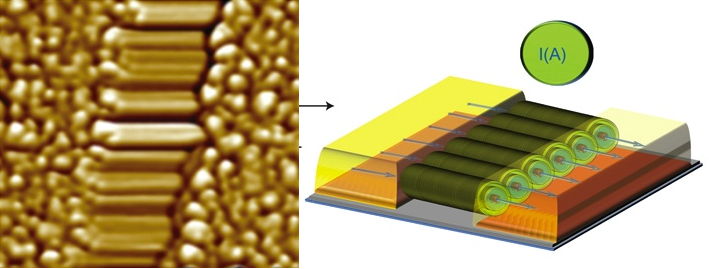
They conduct nearly as well as copper, and made extremely low-resistance contact with the electrode surfaces they're connecting. Even better? They're self-assembling with an easy to control "on" switch, and charging the electrodes before triggering the self-assembly means the wires build themselves between the charged electrodes and nowhere else.

Bioreactor growth rates

My home bioreactor took 48 hours to get going where the instructions said 24-36 hours was typical, but it got going. About two weeks after startup the active cell culture had matured and I decided to put it into production. The instructions indicated that 1.5 hours at room temperature would be an adequate first stage reaction period. Four hours into it the first reaction stage wasn't finished, so I put the lot into the fridge and went to bed; clearly the time estimates were not representative.

I knew putting it in the fridge would slow the reaction down to the point where I could pick it up again the next day, because it's a bioreactor and they're sensitive to temperature - specifically, the reproduction rate of the cell culture slows down dramatically when cooled.

That's when I realized that my bioreactor had been reacting more slowly than the instructions suggested was normal every step of the way.

Calcium Catastrophe

Generally speaking, a sudden drastic change in the chemistry of your environment is catastrophic. From bacteria to humans, there is a range of chemistry we can tolerate, and outside that range we tend to die.

I mentioned one major geochemical event last year, when free atmospheric oxygen first became common. That was a pretty catastrophic change for the living creatures (bacteria) who were adapted to the pre-oxygen conditions of the early earth.

Some time after that, another major geochemical event happened. Some researchers now think that this led directly to the cambrian explosion and to more complex life on earth. Even so, it was a catastrophic change—from the point of view of the creatures who didn't survive it.

Home bioreactor

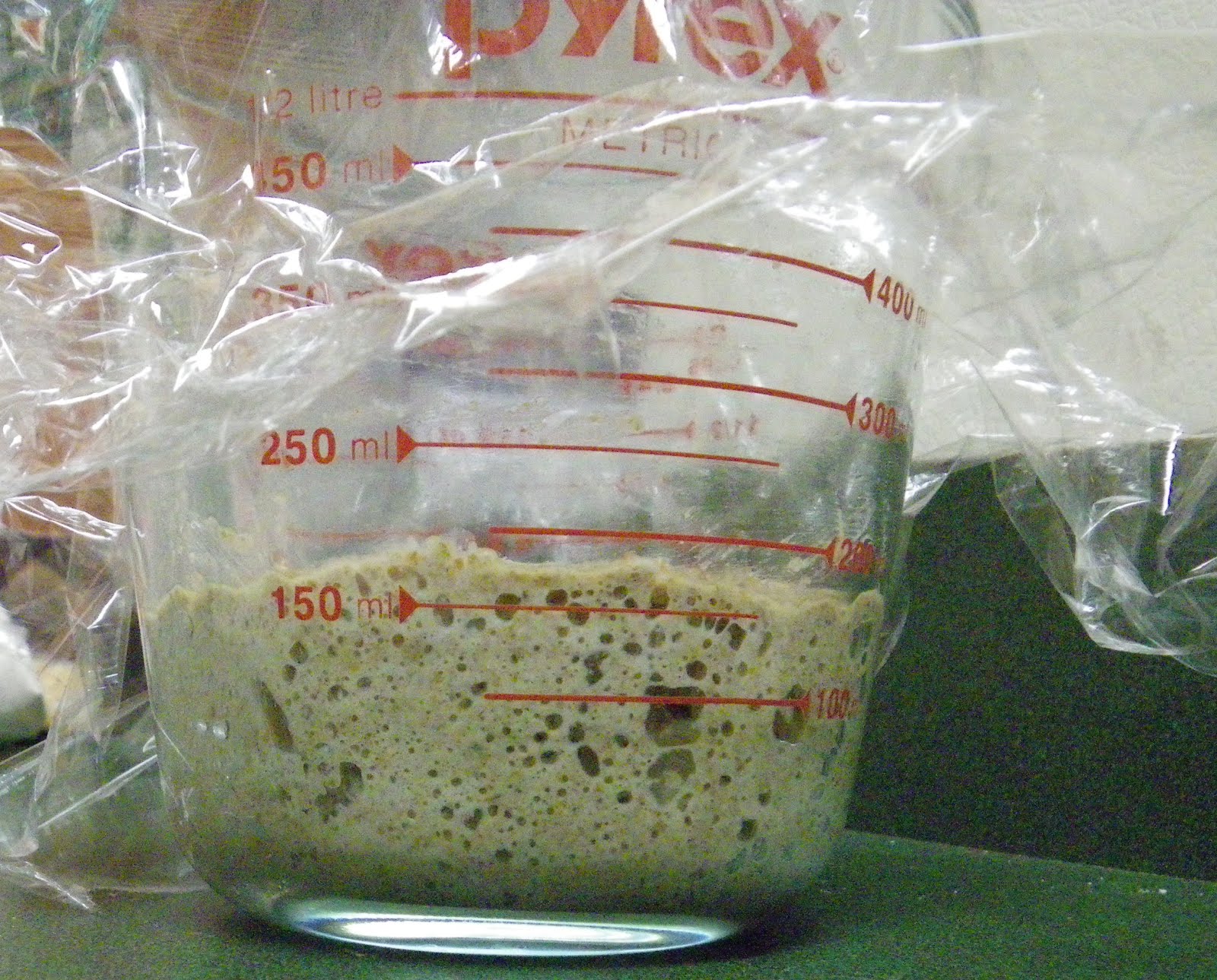
I now have a home bioreactor.

This is what it looks like 48 hours after startup:

Of course, I only realized after the bugs started farting all that CO2 that I didn't actually have a microscope at home to see what they were doing and what was there. I may have to start a second bioreactor after finding myself a microscope capable of seeing who's at home in that jar, to see how the population changes over time.

Hmm, it looks like telescope stores often sell microscopes as well. Magnifying optics are magnifying optics, I guess!

Boiling with salt

Getting back into chemistry after last week's fun little diversion into mechanics, I feel like doing some more math. I was looking for a recipe not long ago and ran across repeated mentions that one adds salt to water when boiling food in order to raise the temperature at which the water boils, thus cooking the food faster.

Boiling point elevation is a real thing, as is freezing point depression, and it's not hard to calculate.

The boiling point of pure water at sea level is 100oC. In order to calculate the change in temperature, we need the following equation:

\[\Delta T = K_b m\]

Inspired by: snakes

More fantastic robots! These ones are inspired by one of the creatures I find the most fascinating: snakes.

This little guy from Carnegie Mellon Biorobotics (still tethered to its power source and remote control) can move in all kinds of ways; as the video says, not just slithering. Quite a few of these types of movement are actually very simple repetitive motions, while others are much more complicated, with more steps in the movement.

Solar Technology - The Next Generation

It wasn't so long ago that photovoltaic solar panels were expensive, hard—and dirty!—to produce, inefficient sources of very expensive power.

In the last little while, however, a flurry of advances have improved on all of those problems. So many announcements have come out lately that I've delayed this post repeatedly due to the sheer quantity of new information. But that's not going to stop, so I'll post what I have now, and I may post again later.

For a super-quick summary of first-generation photovoltaic power, the panels were made of silicon using a process that involves toxic chemicals and high temperatures, were very fragile, expensive, and had a low efficiency and limited lifespan.

But now they're becoming cheap, tough, flexible, easy to make, and remarkably efficient and durable.

Crystal habits

I am fascinated by crystals, particularly by their regularity. They basically consist of a unit cell that repeats over and over again, identically, across the whole span of the crystal. And if the crystal is big enough to see with the naked eye, that's a very large number of unit cells.

Very simple crystals, for example table salt (NaCl), have a tiny unit cell consisting of 4 atoms of Na and 4 atoms of Cl, arranged in alternating rows, a structure that is called face-centred cubic, because on each face of the cube, there's an atom in the centre of the same type as the atoms on the corners of the unit cell.

An interesting quirk of the simple 1:1 ratio cubic crystal structure is that you can define either Na or Cl as the corners of your unit cell, and it'll still be face-centred cubic.

Diamond's structure is also simple: every carbon atom has four links to four other carbon atoms, arranged in a tetrahedral shape around it. Because unit cells are defined as cubic or rectangular shapes, however, the diamond unit cell is less simple, even if the structure itself is simple.

Not a sunrise, but a galaxy rise

I just discovered the "Symphony of Science" series of music videos. Gorgeous visuals in this one, both on the screen and inspired in my head by the lyrics.

I don't really have much to say about it, except that it makes me happy when I watch it. This music video has lyrics made entirely from recordings of things said by Carl Sagan (with a verse by Stephen Hawking), with their tone digitally altered to fit the melody.

Surface tension

Here's a little random bit of fun for today: kitchen games with surface tension.

One of the things that changing surface tension does is determine how stable bubbles are. So, let's change the surface tension of boiling water with some common household items.

If you set a pot of water on the stove to boil, the lid will rattle when it gets going, and that's about the extent of it. The bubbles pop quickly and aren't very stable.

If, on the other hand, you set a pot of water with some white rice in it on the stove to boil (and forget to turn it down to low the instant it starts to boil) it'll foam up and boil over and make a great big mess of your stove. If you're one of the other three people left in the world who both cooks rice and hasn't got a rice cooker, you've probably had this happen to you at least once.

A while ago I noticed something interesting: there are certain additives you can put in a pot of white rice that changes the surface tension yet again, so it goes back to not boiling over. My favourite of these additives is ground coriander seed, stirred in while the water is still cold. Also, it makes for some really tasty rice. Garlic powder also helps: while the water still foams, it doesn't grow as tall and boil over as quickly.