Showing posts with label safety. Show all posts

Unfamiliar noises

I had just picked up a rental car to use during a work trip, of a make and model I'd never driven before. Just as I pulled out of the parkade onto the road leaving the airport and the speedometer moved above the 10, the car shook and a made a sound that had me frantically looking in the rearview mirrors to see what piece of itself the car had just dropped on the road behind me.

Nothing. The road was clear, the car wasn't shaking or making any funny noises anymore, and was accelerating smoothly. Weird.

Just as I pulled off the airport road onto the freeway, and accelerated further, it happened a second time. This was really weird. Still nothing on the road behind me.

It was probably 5 minutes later, as I was driving around a 270 degree freeway ramp to get going the way I wanted, that I figured out what the noise and vibration was. Something not visible inside the rental car parkade, and not in my line of sight when driving the car due to keeping my line of sight on the road.

Impeccable timing on that thunder, Mother Nature.

I'm glad the funny noise wasn't a sign of anything damaged or about to fail, but I've encountered those conditions more than a few times. One reason I pay attention to them!

Gold, with or without cyanide

Some things are unavoidably toxic, and some things were unavoidably toxic until a new, less toxic process was discovered. Less toxic is always a good thing. Sometimes it's less expensive in terms of direct costs such as how much the reagents cost, sometimes less expensive in terms of indirect costs, such as safety precautions and environmental protection.

Sodium hydroxide is one such; the old industrial method of making it involved mercury, which is highly toxic. The new industrial method doesn't. (There are still toxic chemicals involved, but they're not mercury.)

One thing that will hopefully one day be added to the past-tense version of unavoidably toxic is gold mining. Currently, if gold can't be panned from a streambed (placer mining) where it's present as pieces of fairly pure gold, it has to be dissolved out of the rocks, often using cyanide. A newly discovered process is being described as possibly displacing the cyanide.

Don't look under the hard hat

One morning, my co-worker picked up a hard hat off a chair in the site office trailer. This would normally have been a perfectly normal thing but on this day, there was a tarantula hiding in the cozy, dark, and air-conditioned cool place it had found overnight.

After a bit of surprised dancing, the tarantula was left alone. They're pretty mellow and not dangerous, and besides, we had to get to work outside in the hot.

A while later when we went back into the office, the tarantula was on the ceiling. With a hard hat minus its harness, we got the tarantula into the hard hat to put it outside. After, of course, my co-worker asked for a photo of himself with the tarantula.

The tarantulas, as scary as they look, weren't the scary ones in that area. It was the sort of place where you banged your boots around a few times before putting them on in the morning to make sure nothing had taken refuge inside.

I never had anything inside my boots, but one morning I did wake up to a scorpion on my pants.

Greenwashing and CBC #7: Simple Green All-Purpose Cleaner

Continuing from last week with #7 on the CBC Marketplace "Lousy Labels" greenwashing list is Simple Green All-Purpose Cleaner.

As I mentioned last week, Marketplace is a 22 minute show and they did a 10-product countdown, giving them approximately 2 minutes per product, so they had to leave a lot of information out.

So, first things first: the Simple Green MSDS.

Greenwashing and CBC #9: Sunlight Green Clean Laundry Detergent

Continuing from last week with #9 on the CBC Marketplace "Lousy Labels" greenwashing list is Sunlight Green Clean Laundry Detergent.

As I mentioned last week, Marketplace is a 22 minute show and they did a 10-product countdown, giving them approximately 2 minutes per product, so they had to leave a lot of information out. I am the CC so I am filling the (chemistry side) gaps, to satisfy my own curiosity.

As always, I start with the MSDS to get an ingredients list.

Greenwashing?

Just this past weekend, CBC Marketplace did another one of their consumer product reviews, digging into the reality behind the marketing claims. This one is of special interest to me, because I'm both a chemical engineer and and an environmentally conscious person, and it demonstrates pretty clearly why a lot of people believe that combination isn't possible.

This episode was titled Lousy Labels: Home Edition (video, 22 minutes; text summary of their findings) and tackled "greenwashing", or overblown claims of being environmentally friendly, specifically on household products.

Since it's a 22 minute show and they covered ten products, that leaves about 2 minutes per product. There's a lot they had to leave out to fit inside that time limit.

So, because I am interested in learning, interested in being environmentally friendly, chemically inclined, and perpetually looking for something interesting to write about, I decided to take a closer look at these products.

Oh, and since I'm a chemical engineer and some people will be suspicious of me because of that, I will state up front that I have no relationship with any of the chemical products or companies talked about in this show. I don't do consumer goods, I do industrial scale environmental cleanup type stuff.

I'll do them in the same order that Marketplace did, which means I will start with #10: Raid EarthBlends Multi-bug Killer.

Computer researcher

Looks like computers are opening up even more areas of chemistry!

Earlier this year I posted about some software that can predict crystal growth conditions.

Now, there's new software coming out that can predict organic chemistry reactions.

Organic chemistry isn't my field, so unlike the crystal software I probably won't be able to justify a purchase to my boss, but I can still think that this is pretty amazing. The researchers spent a good solid ten years putting the sum total of all organic chemistry knowledge from the past 250 years into a database.

Not only can the computer search possible reaction pathways to make whatever compound you want, you can also filter those results. For example, pathways that use only non-toxic ingredients, or pathways with fewer reaction steps.

In one excellent example, the software came up with what they're calling a "one-pot" reaction for an asthma drug, which is normally produced with four separate reaction and separation steps. The suggested one-pot reaction said that they could put all the ingredients in the same flask in a specific order with specific timing—but with no separation steps, which are often complicated and expensive—and get the asthma drug they wanted—so they tried it.

It worked.

This software sounds like it can lead to the truly ideal case that chemical engineers wish for: faster, cheaper, and safer all at the same time. There are a lot of reactions that use dangerous chemicals, because we don't know of alternate reactions to produce the same thing. Sometimes, research eventually reveals an alternate; for an inorganic example, the production of sodium hydroxide used to involve mercury, which is very toxic even in very small amounts. Now, the mercury process is rarely if ever used, because better and safer processes have been found.

Inspired by: snakes

More fantastic robots! These ones are inspired by one of the creatures I find the most fascinating: snakes.

This little guy from Carnegie Mellon Biorobotics (still tethered to its power source and remote control) can move in all kinds of ways; as the video says, not just slithering. Quite a few of these types of movement are actually very simple repetitive motions, while others are much more complicated, with more steps in the movement.

What did I learn?

Some random stuff I've learned from my field work: some of this is really blindingly obvious in retrospect, but which I didn't learn in university and thus didn't think of until I ran into it, sometimes embarrassingly face first and sometimes by trying to use an existing bad design.

> Operations and maintenance don't like crawling on their hands and knees on gravel to get at equipment that needs maintenance.

I told you some of these would be blindingly obvious. I have seen limited access to not only equipment for maintenance, but also to valves that need to be used on a regular basis. I have also personally needed to work a valve several times per day where I had to thread my hand between several tubes just to reach it. Fortunately I have skinny hands, and none of the tubes were hot.

Don't plug the pressure relief valve.

The pressure relief valve is one of my favourite pieces of safety equipment.

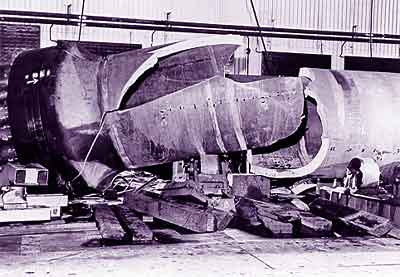
In this case, it's just a simple valve that's designed to leak if the pressure gets above a certain point on one side. By letting a small leak happen, you avoid having the pressure get higher than the tank or pipe is designed to handle. If the pressure in a tank gets higher than it's designed to handle, you get stuff like this:

They aren't only on large industrial systems though.

That one was a little bitty (5 gallon, according to the public safety notice I found it on) hot water tank that exploded. A full size hot water tank does a lot more damage, such as done by this 80 gallon commercial hot water tank installed for a school cafeteria. Did I mention you don't ever plug the pressure relief valve? It's there for a reason.

And because it involves explosions, mythbusters naturally did a couple of episodes to find out if a hot water tank really does launch itself like a rocket and if it really can punch through the 2nd floor then the roof of a 2-story house.

So yeah, if your hot water tank has a dripping valve, don't plug it—call the repairman and put a bucket under it until then.

The reverse of a pressure relief is a vacuum relief, which lets air into tanks that you're emptying. Like this one:

Simulated Failure

Simulating normal operation is something that's been done for a while now, ever since computers got powerful enough to do it. Once validated, a model of, say, a stirred tank, will let an engineer consider where two liquids being mixed are not mixing properly, or where fragile solids are likely to be broken because the shear is high, and adjust the design accordingly before the manufacturer ever cuts metal.

I started by talking about fluid dynamics simulation because that and chemical reaction simulation are the two aspects I'm most likely to work with. Other simulations which could affect me but are outside of my field are materials and mechanical related - pipe and tank fractures, for example. The stresses and weak points of a piece of equipment are something I have to trust to a mechanical engineer, but I have to think about it at least a bit, because what's inside those tanks and pipes is sometimes hot, sometimes toxic, sometimes corrosive, or other forms of dangerous and undesirable to have present outside the equipment, and I have to know what kind of safety features and procedures I have to put in place, from sensors to detect a small leak to secondary containment to prevent a catastrophic spill from escaping and doing even more damage.

Delayed effects

Pin holes in my jeans, above the knee. How did that happen? I don't remember them being there before I put them in the laundry. There were a half dozen on each thigh, ranging in size from just a few broken threads to something I could put a pencil through.

I wore them anyway; they're my work grubbies, intended to get dirty or damaged.

While titrating a sample, I realized a possible route to those holes. The sample was about 2 litres; the chemical dropped in from well above the edge of the container. If micro-drops had splashed back out, unseen, and landed on me, the chemicals involved could have eaten holes in my jeans. But I hadn't noticed them until after doing laundry. After getting them wet.

Here's a funny paradox for you: 98% sulphuric acid is safer (or at least easier to store) than 50% sulphuric acid. Why? Because 98% doesn't have enough water in it to dissolve the acid and activate it. Not saying it isn't still very dangerous stuff: it is, and if water gets in the tank you're in trouble.

Maybe the chemical droplets stayed on my jeans until the water activated it enough to eat a bit of the fabric, until the wash cycle diluted it to the point where it couldn't do anything anymore.

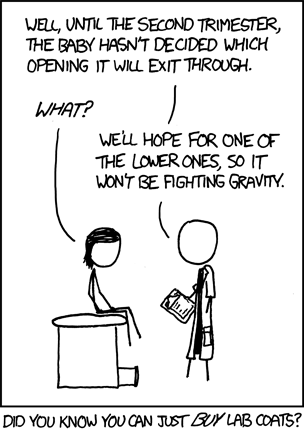
I think it's time for a lab coat. Must ask the boss for one. It's safety gear!

Puff

There's nothing quite like standing on top of a tank in the hot summer sun, surrounded by other tanks all reflecting the heat back up at you. Except, maybe, if you're wearing a full face gas mask and taking samples of a gas that is just about everything bad you can call a chemical.

Toxic, corrosive, flammable, explosive, carcinogenic… The whole system ran at a slight negative pressure, so that if there were any leaks air would go in instead of toxic gas leaking out, and they monitored it carefully to keep the concentration out of the explosive range.

I was testing the performance of a new scrubber which was taking the gas in question out of the exhaust, so I had to climb up to the top of the tanks then up on a scaffold, carrying a vacuum flask, to stand next to the exhaust stack and suck a sample out of the flow. All around me were explosion hatches; small explosions ("puffs") were undesirable but routine, and there was a well-established procedure for re-starting the system after it shut itself down following a puff.

For all that, it was pretty safe: as safe as it could be, considering the material. One day when I was taking a sample, a puff happened while I was on top, and I barely noticed it. I think I heard a bang as the explosion hatches jumped, but by the time I turned to look they had fallen back into place and re-sealed the tank, exactly as they were designed to do.

The gas mask was uncomfortable, but I was happy to be wearing it. It sealed all around my face, forehead to chin, and the sweat it generated improved the seal. I couldn't wipe the sweat off my face however, and it's no fun to get sweat in your eyes while you're climbing around a scaffolding system.

After a couple of weeks of this (I could only take one in/out sample set per day, and if there was a process upset that day I had to throw my results out) I noticed that my hair smelled … strange. For all it was a treated gas stream, with low levels of the toxic chemical, I had been spending enough time exposed to it that the gas had started doing something to my hair. The smell was that sickly-sweet smell of rotting fruit, and it lingered for a week or so after I finished that particular project. It took a few washes before the smell finally went away.

That smell in my hair was the only effect the gas had on me. Gas masks are wonderful things.

Saturated gas masks are worse than useless

Activated carbon is a pretty amazing material. It's just carbon, the same stuff as in charcoal, diamond, and the carbon black that shows up on the bottom of pans and kettles used over flame, for those who have gas stoves or enjoy camping. At the same time, it's an incredibly important material for purification, because one of the neat things that activated carbon does is trap toxic stuff by adsorption. It doesn't catch everything, but it catches so many different things that it's often used in gas masks when you don't know what toxic gas you might encounter - for a HazMat team, for example, those who aren't using SCBA tanks.

One unfortunate problem with any filtration system is that the filter itself has a limit to how much crap it can capture from the water or air that's passing through - and the filter can't tell you when it's getting full. How do you know when it's time to change your Brita filter? How does a HazMat team know when their gas masks stop working? In a plant situation with large equipment, you can install sensors to monitor for breakthrough, but that's not practical, and sometimes not even possible, on small portable filtration systems.

A team from the University of California San Diego recently published in the journal Advanced Materials a paper on the production of carbon nanofiber photonic crystals. These are a special crystal form of carbon which, once they've captured toxins, change colour. No power required, no special equipment required, no extra weight for HazMat to carry. These crystals can be embedded right in the activated carbon filter, so they see exactly the same level of toxin as the filter itself. If you embed them at varying depths in the filter, you could actually watch the adsorption front as it moved through the filter, and know with certainty when your filter is getting close to breakthrough, and thus when it needs to be changed.